
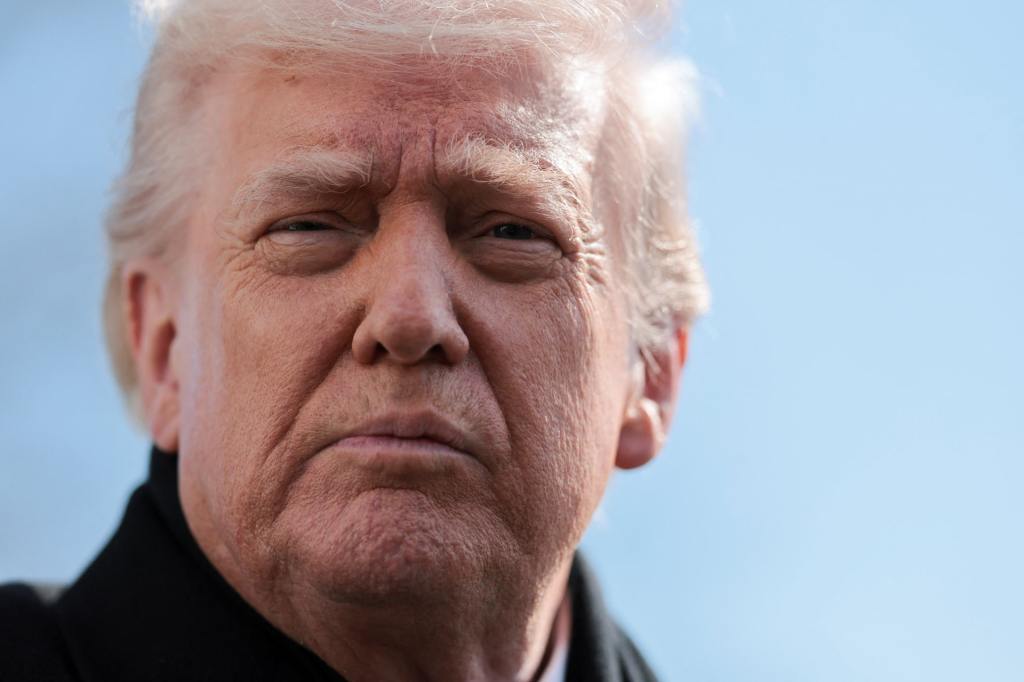
The Big Picture: On January 27, President Trump broke his silence on the currency markets, declaring the value of the U.S. dollar is “great.” The statement is a strategic pivot, aimed at projecting confidence even as the gold market signals a historic crisis of faith in paper assets.
Why it Matters: The divergence between Washington’s “Confidence” and the COMEX’s “Chaos” signals a historic breakdown in trust. When the President calls a four-year low in the dollar “great,” the market reads it as a policy of benign neglect—suggesting the administration may actually want a weaker dollar to fuel exports and offset his 10% “Liberation Day” tariffs.
1. The Rhetoric of Strength
Trump’s “doing fine” stance is designed to calm a market rattled by the $3.4 trillion “One Big Beautiful Bill” (OBBBA).
- The Strategic Goal: If the President signals he is comfortable with the dollar’s value, it discourages “panic-buying” of gold. It’s an attempt to use the “Bully Pulpit” to do what interest rate hikes haven’t yet accomplished: anchor the currency.
- The Market Gap: There is a growing delta between the President’s optimism and the reality of the COMEX, where silver recently flirted with $100/oz. Markets are now asking if the administration is genuinely confident or simply “talking up” the currency to prevent a further slide.
- The “Fed Shadow”: Trump’s prediction that interest rates will “decline once the new chair takes over” (following his upcoming nominee to replace Jerome Powell) signaled to markets that the era of “higher-for-longer” rates is over.
- The Result: Since gold and silver pay no interest, they become exponentially more attractive when the U.S. President explicitly calls for lower rates. This “Trump Bounce” pushed gold up 3.7% in a single session.
2. Weaponizing the Dollar vs. China
The “great value” of the dollar is a central pillar of the administration’s trade war with Beijing.
- The Tariff Connection: A strong dollar makes imports cheaper for Americans, which helps offset the inflationary sting of the 10% “Liberation Day” tariffs.
- Global Settlement: By asserting dollar dominance, Trump is directly challenging China’s attempts to settle oil and commodity trades in yuan. The message to global allies: The dollar is still the only game in town for secure trade.
3. The Internal Struggle: Growth vs. The Vacuum
The administration faces a “Three-Body Problem” in financial policy:
- Fiscal Expansion: The OBBBA stimulus requires massive borrowing, which typically devalues a currency.
- Monetary Vacuum: The Federal Reserve is trying to “dry” the market of excess dollars to fight inflation.
- The Gold Fever: Investors are using gold as a “fire escape” to avoid the volatility between the first two forces.
4. The Silver “Meme” and Industrial Squeeze
While the White House focuses on the dollar, the silver market has entered a “liquidity vortex.”
- Speculative Fever: Despite the CME Group hiking silver margins to 9.9%, the price hit $113.62 today. Analysts at J.P. Morgan describe the move as “meme traders attempting to take over the market,” similar to the retail frenzies of years past but on a global, institutional scale (Seeking Alpha, 2026).
- The Shutdown Fear: Adding fuel to the fire are rising 80% probabilities of a U.S. government shutdown by the end of this week. Gold and silver are the only “safe harbors” when the federal government’s ability to pay its bills is in question.
5. Signaling Disorder: The China & Japan Factor
The dollar isn’t just fighting metals; it’s fighting a global “flight from debt.”
- Japan’s Spillover: A sharp sell-off in Japanese Government Bonds (JGBs) has bled into global markets, forcing investors out of sovereign debt and into tangible assets.
- The Beijing Narrative: As gold crosses $5,300, China’s state media is framing the surge as the “end of the unipolar monetary era.” By backing the yuan with increasing gold reserves (now over 2,300 tonnes), they are positioning for a world where the dollar is just one of many options.
6. Tactics: The “Invisible Hand” of Regulation
While the President talks up the dollar, his administration is moving to make the “competition” (Gold and Silver) less attractive:
- Margin Wars: The CME Group’s move to percentage-based margins (up to 9.9% for silver) was a calculated “speed limit” to crush speculators betting against the dollar.
- Paper Shorting: Rumors persist that bullion banks are being encouraged to “flood the tape” with paper gold shorts to suppress the $5,100 price point and align market reality with the President’s “great value” rhetoric.
The Bottom Line
Trump’s endorsement of the dollar is a high-stakes play for time. He needs the dollar to stay “great” to fund his domestic agenda, but he must achieve this without triggering a “gold rush” that exposes the cracks in the U.S. fiscal balance sheet.
The administration is caught in a “Golden Trap.” If they talk up the dollar, markets see a bluff; if they admit weakness, the slide accelerates. With silver at $113 and gold at $5,300, the “fever” isn’t breaking—it’s moving into a dangerous new phase of price discovery where old resistance levels no longer apply.
Further Reading & Sources
- Channel News Asia (Jan 28, 2026): Gold climbs to record high above $5,300 as dollar slips – Real-time reporting on the post-Trump comments rally.
- Brookings Institution (Jan 2026): Robin Brooks on the Global Debt Inflection Point – Why the dollar’s safe-haven status is facing a “technical breakdown.”
- Seeking Alpha (Jan 26, 2026): After $100 Silver and $5K Gold, What’s Next? – Contrarian view on the “meme-led” rally and potential for a 50% correction.
- Discovery Alert (2026): Structural Imbalances Driving Record Precious Metals Performance – Analysis of how governments use currency debasement to manage debt.


 Cornellian Perspectives
Leave a comment