
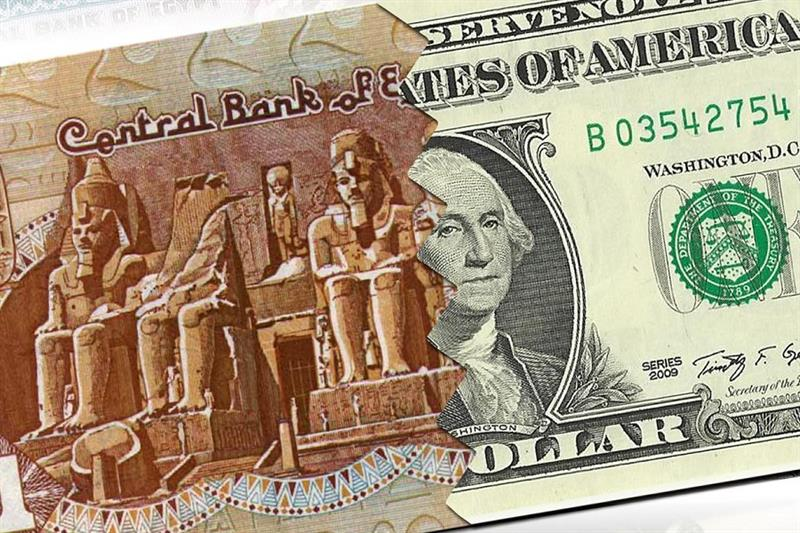
State of Play. Currently, their are two exchange rates, the official exchange rate for the Egyptian Pound (EGP) against the US Dollar, at around 31, and the black market rate, which peaked at 72 in end of January.
The official exchange rate is used by the commercial banks, accredited exchange houses, and the central bank. In reality, it is used for accounting purposes, and less for day-to-day use: the central bank manages a tight currency exchange platform for importing businesses to access hard currency at the official rate, and individuals obtain the official when showing proof of travel and under limited conditions.
Currently, the government is trying to tame the black market, through security measures and controlled sharing of economic news to nudge the informal exchange rate.
Zoom in. Egypt’s chronic trade deficit, coupled with high fiscal spending, changes in the global macroeconomy since the pandemic, and spillover effects on Egypt’s national economy from the rising geopolitical challenges (Ukraine, Gaza, Sudan etc) – increased import costs, lower tourism, flight of foreign investments, increasing number of refugees, and declining state revenue from the Suez canal – have all contributed shortage of hard currency.
This in turn has fueled policies curbing imports, successive need to devaluate the national currency, and sustained double digit inflation. The Central Bank of Egypt (CBE) initially tried to tackle inflation through raising the interest rates, but things have gone out of hand as managed devaluations failed. Egypt was unable to substantially decrease its trade deficit and attract foreign currency, whether through devolution of state assets or attracting foreign investments.
Zoom out. A black market for hard currency has flourished. CBE stuck with managed devaluation and fixed exchange policy. Remittances flowed into the black market to benefit from the higher black market exchange rate. Business and individuals flocked to the black market to secure their needs for hard currency and safeguard their capital. Commercial banks were unable to compete with the informal black market traders because of the fixed exchanged rate, and their balance sheets have shrunk with each round of devaluation.
The big picture. The International Monetary Fund (IMF) is working with the Egyptian government to tackle its inflation problem (currently at an average of 40%) – which the government has prioritized, unify the exchange rates (through an unmanaged currency floatation), and reform the economy (primarily the state’s intervention in the markets, crowding out the private sector). Since the beginning the war in Ukraine, the IMF has extended financing to Egypt. Nevertheless the $3 billion economic reform program has stalled, with the IMF reviews and loan transfers delayed.
With the spillover effects of the war in Gaza (lower tourism and income from the Suez Canal) and the risk of instability, the IMF is moving to put in place a new Memorandum of Economic and Financial Policies (MEFP). Egypt and the IMF are still negotiating the magnitude of additional support from the IMF and other bilateral and multilateral development partners needed to help close Egypt’s increased financing gaps in the context of recent shocks.
The dilemma. Egypt is stuck between a rock and a hard place. It needs a lifeline of hard currency to foot the bill for an unmanaged floating of the currency. The lifeline is the IMF, but it does not come without reform costs and will take time. And the lifeline is not enough to fill the gap beyond the short term. Even if CBE is fully onboard with a floating exchange rate, Egypt will still face a deficit and shortage of hard currency to cover daily needs until the major structural economic reforms – that decrease the trade deficit, manage the fiscal spending, and reform the subsidy system – kick in.
Over the past three years, Egypt has effectively sidelined its banking sector by sticking to its fixed exchange rate policy. Essentially, anyone in fast need of hard currency turned to the black market. The commercial banks’ sole role was to contribute to the purchase of treasury bills and bonds. Their role was to effectively to absorb Egyptian pound liquidity from the market, focusing primarily on swaying individuals away from the pursuit of hard currency by offering high interest rates on government bonds – which in reality, given the inflation – where negative interest rates.
The high exposure of banks to government bonds, and their inability to attract deposits in hard currency and recapitalize against the successive devaluations has left Egyptian banks exposed and has resulted in downgrading their ratings, similar to the downgrade of Egyptian government bonds ratings into junk territory.
The silver lining. Without the commercial banks, the lifeline from the IMF cannot be sustained until the reforms materialize. CBE needs to involve the banking sector and keep the hard currency within the formal economy and the banking system. Both CBE and the commercial banks have the tools and experience, it only requires some innovative financial engineering.
How it works. Unconventional times require unconventional measures. CBE would need to allow commercial banks to buy hard currency (essentially USD) at black market rates, and continue to sell it at official rates, still using the tight measures for both business and individuals. CBE would offer the EGP liquidity overnight to banks through repos to enable the commercial banks to buy USD at black market rates, and take the liquidity out through reverse repo.
This essentially would help the commercial banks recapitalize their decaying balance sheets (with every other devaluation), revitalize their role in the economy, incentivize individuals to take out the USD from under the mattresses, and bring back the remittances into the banking sector.
In short, what is a Reverse Repo?
The US Federal Reserve uses reverse repos in a few key ways to manage the financial system:
1. Taming Interest Rates: Imagine banks lending each other money overnight. The Fed uses reverse repos to nudge that rate (called “federal funds”) where it wants it.
2. Draining Cash (Like a Financial Sponge): Too much cash floating around? The Fed “borrows” it through reverse repos, taking it out of circulation and cooling inflation.
3. Safe Haven for Money Parkers: Need a secure spot for your cash overnight? Reverse repos offer banks and others a risk-free option, keeping the financial system humming.
Simplified. How does a reverse repo work?
- Think of it like a mini, secured loan:
- The Fed “sells” government bonds to institutions for a day.
- They give the Fed cash in exchange.
- The Fed buys back the bonds later, paying a small “interest” fee.
Yes, but Egypt already does some version of Reverse Repo, it has just to tweak it. CBE uses similar tools to the US Federal Reserve’s reverse repo, but with key differences that limit its effectiveness.
The Similarities:
- Taming Liquidity: Both the CBE and Fed use auctions to absorb excess cash from banks, controlling inflation and maintaining financial stability.
- Rate Influence: By setting auction rates, both indirectly influence overnight lending rates between banks, guiding monetary policy.
- Safe Haven: Both offer risk-free options for banks to park excess cash.
The Key Differences:
- Name Game: The CBE calls the tools “Certificate of Deposit (CLD) auction and Main Operation (MO): 7-Day Deposit Auction,” while the Fed uses “reverse repo.” Functionally, they’re similar, but the terminology can cause confusion.
- Maturity Mismatch: The CBE’s MOs and CLDs range from 7 to 210 days, while the Fed’s reverse repos are typically overnight. This limits the CBE’s flexibility in managing short-term liquidity fluctuations, which are needed for the banks to compete with the black market in buying USD.
- Recent Reliance: Due to economic challenges, the CBE has heavily relied on CLD auctions in 2023-2024, but their effectiveness is debated, given their longer term duration.
The Bottom Line: While Egypt uses a similar tool, its “reverse repo” needs tweaks to fit its needs in managing the exchange rate. Aligning terminology and shortening maturities could be key steps to engineer a tool that the CBE can use in the market, utilizing the power of commercial banks. This would allow hard currency to flow back into the formal economy and banking sector, and relieve Egypt’s short term USD needs.




 Cornellian Perspectives
Leave a comment